HCOOCH CH2 H2O is an intriguing chemical compound that attracts attention in both academic and industrial chemistry. While not as commonly discussed as other organic molecules, it plays a crucial role in reactions involving esters, formic acid derivatives, and water-based chemical transformations. Understanding this compound offers insight into chemical behaviour, molecular interactions, and its applications in laboratory and industrial processes.
The study of HCOOCH CH2 H2O is essential for chemists aiming to explore organic reactions, hydrolysis processes, and the synthesis of valuable intermediates. Its relevance spans multiple fields, including pharmaceuticals, materials science, and chemical engineering, making it a compound worth studying for both practical and theoretical purposes.
What is HCOOCH CH2 H2O?
HCOOCH CH2 H2O represents a molecule that combines elements of formic acid and water with a methylene group. Chemically, it is considered a derivative of formic acid esters, often involved in hydrolysis reactions. The compound is notable for its versatility in forming various chemical products when combined with water or other reactive substances. Understanding its composition is the first step towards exploring its chemical applications and behaviour.
In addition to its chemical formula, HCOOCH CH2 H2O is known for its ability to participate in reactions that produce formic acid or related compounds. Its unique combination of functional groups allows it to act as an intermediate in synthesis reactions, making it an important molecule for industrial chemists and researchers working on organic transformations and environmentally safe chemical processes.
Chemical Structure of HCOOCH CH2 H2O
The chemical structure of HCOOCH CH2 H2O consists of a formyl group (HCOO), a methylene group (CH2), and water (H2O) components. This configuration allows the molecule to participate in ester hydrolysis and other organic reactions. Its structural arrangement is crucial for understanding its reactivity and interaction with other chemicals, particularly in aqueous solutions.
Visualising the structure highlights how the molecule’s functional groups influence its chemical properties. The formyl group, for example, contributes to acidity and reactivity, while the methylene and water components facilitate hydrolysis and reaction with nucleophiles. Knowledge of its molecular arrangement is essential for predicting behaviour in laboratory settings and industrial processes.
Reaction Mechanism and Chemical Behaviour
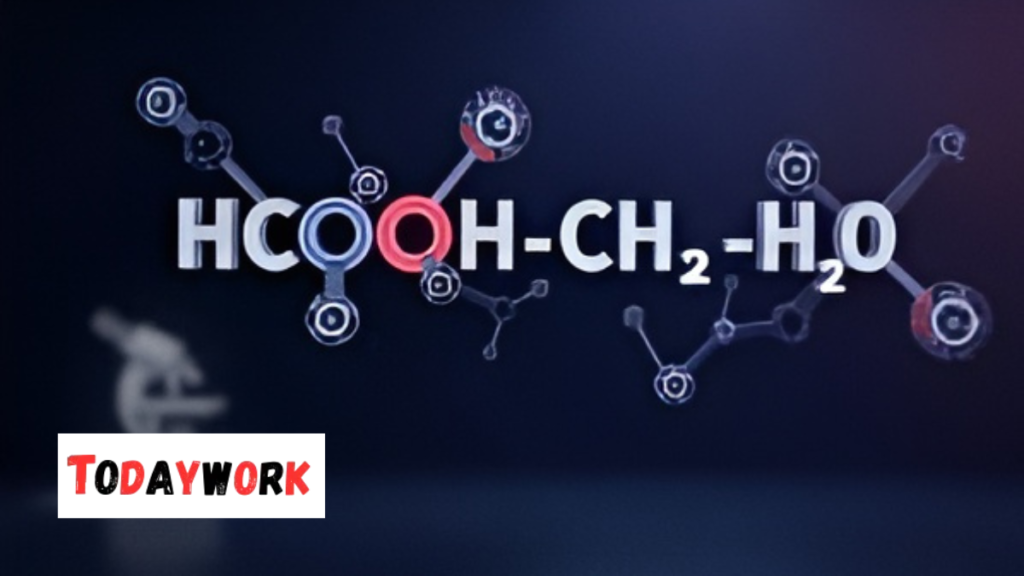
HCOOCH CH2 H2O is involved in several key chemical reactions, particularly hydrolysis of esters. When it reacts with water, it can yield formic acid and methanol, demonstrating typical ester reactivity. Understanding these reactions allows chemists to manipulate conditions such as temperature, pH, and catalysts to achieve desired outcomes efficiently.
In addition to hydrolysis, HCOOCH CH2 H2O can undergo other chemical transformations, including oxidation and substitution reactions, depending on the reagents and environment. Its behaviour under various conditions makes it a versatile compound in organic synthesis and research, providing opportunities for innovation in chemical engineering and industrial chemistry.
Physical and Chemical Properties
HCOOCH CH2 H2O exhibits distinct physical and chemical properties that influence its handling and applications. It is typically a colourless, soluble compound in water and exhibits moderate acidity due to the formyl group. Its melting and boiling points are influenced by its molecular structure and hydrogen bonding potential, which also affects solubility and reactivity.
Chemically, it is relatively stable under standard conditions but reacts readily in the presence of water or strong nucleophiles. Its stability and reactivity balance make it useful as an intermediate in synthesis reactions, while its solubility in water ensures it can be employed in environmentally friendly chemical processes. Proper handling and knowledge of its properties are essential for laboratory safety and industrial efficiency.
Applications and Uses
HCOOCH CH2 H2O finds applications in both industrial and laboratory settings. In the chemical industry, it serves as an intermediate in the production of formic acid derivatives and other esters. Its role in hydrolysis reactions makes it valuable for synthesising compounds used in pharmaceuticals, coatings, and chemical reagents.
In academic research, HCOOCH CH2 H2O is employed to study reaction mechanisms and the behaviour of esters in aqueous conditions. Its versatility and predictable reactivity allow chemists to explore new synthetic pathways, design experiments, and develop sustainable chemical processes. Emerging applications also include materials science and green chemistry initiatives, where understanding its properties is critical for innovative uses.
Common Misconceptions
A common misconception about HCOOCH CH2 H2O is confusing it with simple formic acid or methyl formate. While related, the presence of the methylene and water components gives it distinct reactivity and structural properties. Misidentifying the molecule can lead to errors in synthesis and experimental design.
Another area of confusion involves its naming and classification. Correctly identifying it as a formic acid ester derivative clarifies its function in chemical reactions and ensures accurate communication among chemists. Addressing these misconceptions is important for students, researchers, and professionals working with this compound.
Conclusion
HCOOCH CH2 H2O is a unique and valuable chemical compound with important applications in chemistry and industry. Its structure, reaction mechanisms, and properties make it essential for organic synthesis, hydrolysis studies, and industrial chemical processes. Understanding this molecule contributes to safer, more efficient, and innovative chemical practices.
From laboratory research to industrial production, HCOOCH CH2 H2O continues to demonstrate its relevance and versatility. By studying its reactions and applications, chemists can harness its potential for creating new compounds, optimising processes, and advancing scientific knowledge in both academic and practical contexts.
Frequently asked questions
What is the chemical formula of HCOOCH CH2 H2O?
HCOOCH CH2 H2O is a derivative of formic acid esters combined with water and a methylene group, commonly involved in hydrolysis reactions.
How does HCOOCH CH2 H2O react with water?
It undergoes hydrolysis to produce formic acid and methanol, demonstrating typical ester reactivity.
What are the main applications of HCOOCH CH2 H2O?
It is used in industrial synthesis, pharmaceutical research, and laboratory studies of ester reactions.
Is HCOOCH CH2 H2O the same as formic acid?
No, it is a derivative that includes additional methylene and water components, giving it distinct chemical properties.
What safety precautions are needed when handling HCOOCH CH2 H2O?
Standard laboratory safety measures apply, including gloves, goggles, and proper ventilation, due to its reactivity in aqueous conditions.
How is HCOOCH CH2 H2O synthesised in the lab?
It is typically prepared through the hydrolysis of formic acid esters under controlled conditions.
What functional groups are present in HCOOCH CH2 H2O?
The molecule contains formyl (HCOO), methylene (CH2), and water (H2O) groups, which influence its reactivity and applications.
Also Read: utdplug