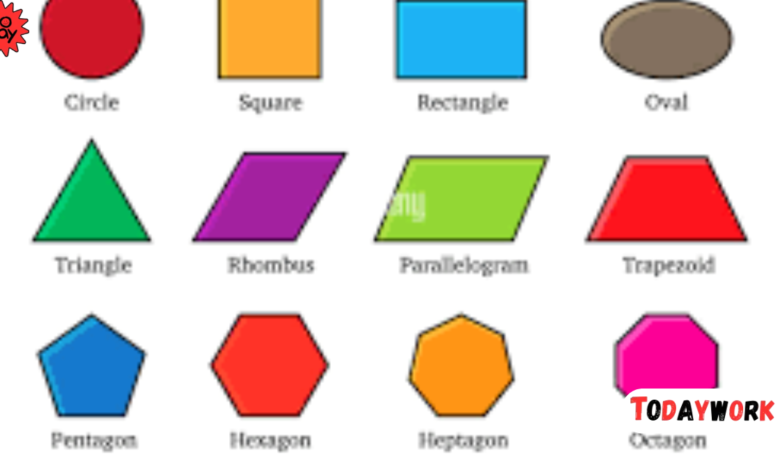
A rhombus shape is a key geometric figure that plays an important role in mathematics and everyday life. Recognisable for its four equal sides, this shape is a type of quadrilateral and a special form of parallelogram. Its unique combination of symmetry, equal sides, and intersecting diagonals makes it both mathematically significant and visually appealing. Understanding the rhombus shape is essential for students learning geometry and for anyone interested in spatial design.
Beyond the classroom, the rhombus shape frequently appears in architecture, decorative patterns, and natural formations. Often referred to as a diamond or lozenge, it is not just a theoretical figure but also a practical and aesthetic shape. Studying the rhombus shape helps develop problem-solving skills, visual thinking, and a deeper appreciation for the application of geometry in daily life.
What is a Rhombus Shape?
A rhombus shape is defined as a four-sided polygon in which all sides are of equal length. Unlike general quadrilaterals, its opposite sides are parallel, and its opposite angles are equal. This combination of properties gives the rhombus shape a balanced and harmonious structure, making it easy to identify in both academic exercises and real-world contexts. Its diagonals intersect at right angles, forming congruent triangles that provide additional mathematical insights.
The rhombus shape is often encountered in both educational settings and practical applications. From teaching geometry to young learners to incorporating its form in design projects, this shape offers versatile use. Its properties also make it ideal for calculating area, understanding symmetry, and recognising patterns in both natural and man-made objects. Learning about the rhombus shape is a foundational step in understanding broader geometric concepts.
Key Properties of a Rhombus Shape
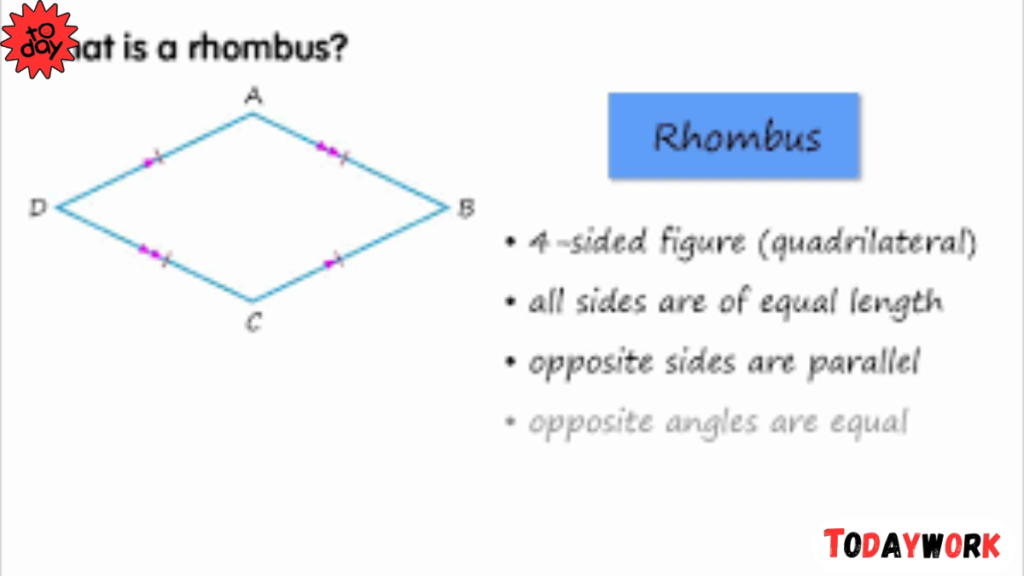
The rhombus shape has several distinct properties that set it apart from other quadrilaterals. All four sides are equal in length, creating inherent symmetry, while opposite sides remain parallel, ensuring geometric balance. Additionally, opposite angles are equal, and adjacent angles are supplementary. These characteristics make it easier for students to solve complex problems involving angles, sides, and area.
Another key property of the rhombus shape is its diagonals, which intersect at right angles. These diagonals bisect each other and divide the shape into four right-angled triangles. This makes the rhombus shape particularly useful for teaching concepts such as congruence and symmetry. It also has rotational symmetry of order two and two lines of reflection symmetry, adding to its mathematical elegance.
Formulas Related to a Rhombus Shape
Calculating the area and perimeter of a rhombus shape is straightforward once its properties are understood. The most common method for finding the area involves using the diagonals: the area equals half the product of the diagonals. This approach is particularly efficient when the lengths of the diagonals are known, allowing for quick problem-solving in both educational and professional contexts.
The perimeter of a rhombus shape can be calculated by multiplying the length of one side by four. Additionally, the area can also be determined using the base and height, providing multiple methods for solving geometry problems. Understanding these formulas equips students and learners with practical tools to approach questions involving the rhombus shape with confidence and accuracy.
Types of Rhombus Shapes

There are several variations of rhombus shapes, each with its own unique characteristics. The standard rhombus is the most common and adheres to all the fundamental properties of equal sides, parallel opposite sides, and intersecting diagonals. This basic form is widely used in educational examples and geometric exercises.
A square is a special type of rhombus shape, distinguished by its right angles at each corner while still maintaining equal sides and parallel opposite sides. In addition, rhombus shapes are often seen in decorative and practical applications, such as kites, floor tiles, and logos. Recognising these different types enhances both visual understanding and practical appreciation of geometric principles.
How to Draw a Rhombus Shape
Drawing a rhombus shape accurately requires a few simple steps and tools. Start by drawing one diagonal and then construct the perpendicular diagonal to intersect at the midpoint. Next, connect the endpoints of the diagonals to form four equal sides. Following these steps ensures the rhombus shape maintains correct symmetry and proportion.
Using a ruler and protractor helps maintain accuracy while drawing a rhombus shape. Practising this method enhances a student’s understanding of angles, lengths, and geometric relationships. Drawing a rhombus shape is also useful for creative design projects and educational activities, providing a hands-on approach to learning geometry.
Real-Life Applications of Rhombus Shapes
The rhombus shape is not just a mathematical concept; it has many practical applications in real life. Architectural designs often incorporate rhombus shapes in windows, floor tiles, and decorative panels, providing both aesthetic appeal and structural balance. Playing cards feature diamonds, which are essentially rhombus shapes, making this figure familiar in everyday life.
Nature also provides numerous examples of the rhombus shape, such as in leaf patterns, crystals, and insect wings. Educational tools often use rhombus shapes to teach symmetry, angles, and area. Recognising and understanding these real-world examples of the rhombus shape helps learners see the relevance of geometry beyond textbooks.
Conclusion
The rhombus shape is a versatile and fascinating geometric figure, with applications in mathematics, design, and nature. Its properties, formulas, and types make it an essential concept for students, teachers, and enthusiasts. Learning to identify, draw, and calculate the characteristics of a rhombus shape strengthens problem-solving skills and enhances understanding of broader geometric principles.
Understanding the rhombus shape also allows for practical applications in architecture, design, and education. By studying this shape, learners gain both analytical skills and an appreciation for symmetry and structure in the world around them. The rhombus shape is not only an academic figure but a shape that bridges the gap between theory and real-life applications.
Frequently asked questions
What is a rhombus shape?
A rhombus shape is a four-sided polygon with all sides equal in length and opposite sides parallel.
How do you identify a rhombus shape in geometry?
You identify a rhombus shape by checking for four equal sides, opposite angles equal, and diagonals that bisect each other at right angles.
Is a square considered a rhombus shape?
Yes, a square is a special type of rhombus shape with all sides equal and all angles at 90 degrees.
How do you calculate the area of a rhombus shape?
The area of a rhombus shape can be calculated using diagonals: Area = ½ × (diagonal1 × diagonal2).
What are the key properties of a rhombus shape?
A rhombus shape has equal sides, parallel opposite sides, equal opposite angles, diagonals that bisect at right angles, and symmetry.
Where can we see rhombus shapes in real life?
Rhombus shapes appear in playing cards, floor tiles, window designs, kites, crystals, and leaf patterns.
How do the diagonals of a rhombus shape work?
The diagonals of a rhombus shape intersect at right angles and bisect each other, forming four congruent triangles.
What is the difference between a rhombus shape and a rectangle?
A rhombus shape has all sides equal, while a rectangle has opposite sides equal and all angles 90 degrees.
Also Read: steal a brainrot roblox

